As anyone who's ever ridden the Metro in Boston knows, there's a sign on the wall along the blue line route that reads, "Outbound to Wonderland." Must be one helluva train, I thought to myself when I saw it. In that spirit of exploration, this is a blog of short essays on art, literature, law, economics, music, history, international relations, science...and everything else, too.
Sunday, September 11, 2011
Polo
Polo, undeniably, is a sport played by and for wealthy white people. The markers of class and attainment which surround it are clear, if not always entirely flagrant. And no doubt where there exists that aura of material ascendancy there will exist as well all the striving, scrambling and jockeying that constitutes a rather breathless game in itself, a kind of unctuous polo of the audience. Hence the (often justified) cliches of pretension and debauchery that pervade many of our conceptions of affluence.
But. But. Having yesterday attended a real-live, honest-to-God polo match, I feel compelled to offer a theory of at least one way in which it might not be entirely indefensible to exist in this otherwise ridiculous realm of excess and ostentation. And it has to do with boots.
How much do the boots these polo players were wearing cost? $700? $900? Who knows. Conceivably enough to pay rent for two months in most mid-sized Midwestern cities. Enough to offend the sensibilities of most everyone I grew up with.
But here's the thing: nobody who's ever played polo buys them because they cost that much. Rather, they buy them because they're worth that much. Stand next to a man standing next to his polo pony, as we did yesterday, and you'll realize what a sophisticated bit of equipment he's wearing on his feet. The zipper, in the classic Argentine design, is on the front and covered with flaps:
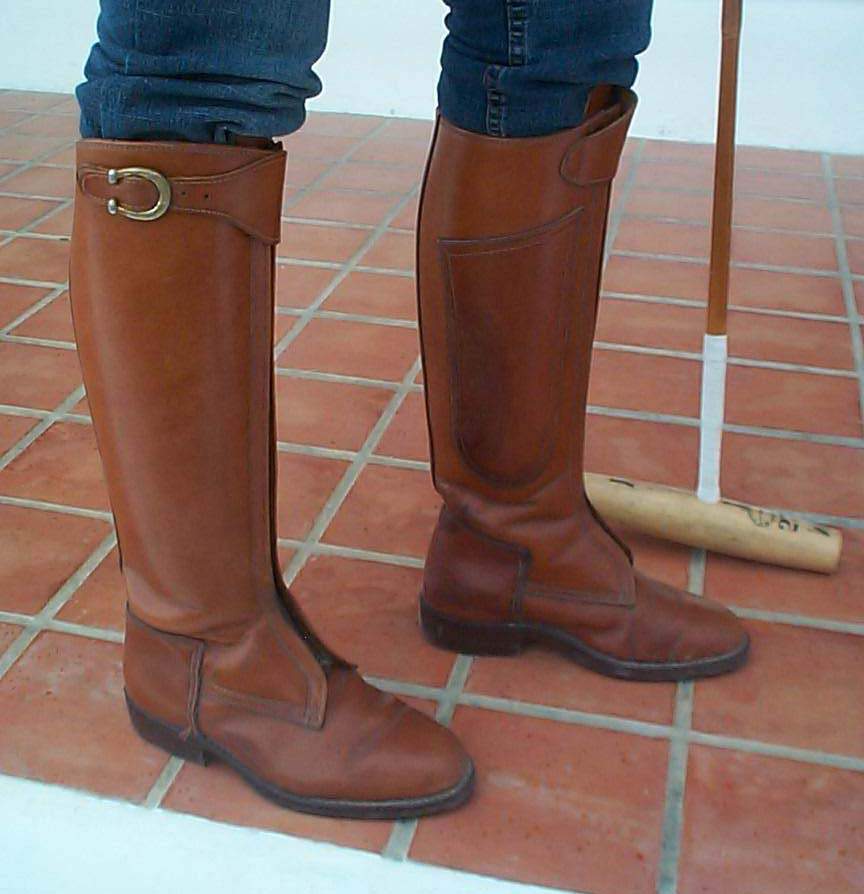
Or, sometimes the boot is even covered with "over-chaps" to prevent wear from rubbing against stirrup irons, or the rider's horse, or his opponent's horse should there be contact:
And about that contact--it is repeated and sustained, these boots must endure the press and grate of horse hair, the seep of horse sweat. These boots, magnificent though they are, are not show pieces. Rather, they are made in anticipation of mud, salt, shit, and yes, frequently spilled beer or gin. They are something that seems to have become strangely rare in our time: they are both beautiful and used.
Now, what the brief and rather tame essay above is not, is an unqualified apology for the aristocratic classes such as they continue to exist here in Northern Virginia, or wherever they might be lurking in the Western world. Rather, it is a proposition. I know from my own experience that what might smack of pretension to some is in fact experienced as an earnest and profound engagement by others. I know that when I wonder out loud about some abstruse question, say, whether or not Chinese trade and investment in sub-Saharan Africa constitutes a 21st-Century reincarnation of colonialism, I'm not doing so in order to impress anybody (because, really, who would ever be impressed by that question?); I'm actually thinking about it. And though we do well always to keep a wry eye on our own aspirations, whether they be aspirations to eloquence, expertise, gentility, or what-have-you, we need nevertheless to be free to aspire fully, desperately even. If we are not thusly free, if we allow our skepticism to inhibit our curiosity, or allow our instincts toward moral disapprobation to overwhelm our patience, then we risk missing so much and being the unhappier for it. As you can see below, Nina and I, deeply in touch with our own pretensions, had a blast at that polo match.
Saturday, August 27, 2011
Homes
Because in my estimation George F. Kennan (Milwaukee native, cold war diplomat, and Pulitzer Prize-winning historian) has said most things better than most of the rest of us will ever say anything, I offer here, on the occasion of Nina's and my re-engagement with Lithuania, a quote from Kennan's incomparable memoirs:
“If Wisconsin, then, was not ‘home,’ what was? Well, there was now Princeton, and the farm in Pennsylvania, and the cottage in Norway. But there was more than that. There were those curious places…where I had felt so overpowering a sense of familiarity as to evoke the mystery of a former life. Home, then, was the whole great arc of the northern and western world, from Moscow across Scandinavia and the British Isles to Wisconsin. One was, in other words, a sort of Nordic cosmopolitan, truly domiciled only in the natural beauty of the seas and countrysides of this northern world; in its seasons and its storms…”
Thursday, August 18, 2011
Sentence of the Day
In case, like me, you're not having any fun with your sentences these days, here's one of William Kennedy's:
It was dark now and I was wet to the underwear, standing in the middle of desolation, maybe about to be buried in a landslide, giving traffic directions to a bleeding, one-eyed psychopath who was, with one hand, trying to drive a mythic vehicle backwards up an enchanted mountain.
Now if that don't put the gnats back in your herb garden, what does, huh? ;)
It was dark now and I was wet to the underwear, standing in the middle of desolation, maybe about to be buried in a landslide, giving traffic directions to a bleeding, one-eyed psychopath who was, with one hand, trying to drive a mythic vehicle backwards up an enchanted mountain.
Now if that don't put the gnats back in your herb garden, what does, huh? ;)
Friday, August 5, 2011
Memorials
What are memorials for, what are they about? Take Abe, above. The stern, but probably not quite admonitory gaze. The impatiently clutched left hand seemingly intended to suggest the impact of those fabled emotional and intellectual burdens which, nevertheless, have failed to degrade the subject's posture or general aura of rectitude. All wonderful, as far as they go. Likely accurate, and therefore evocative. But is that it? Mere evocation? Isn't that a bit obsessive, the constant imperative to remember, remember, remember? Remember what? It almost doesn't seem to matter.
Viewing several of DC's memorials last night with friends who were visiting from, well, Lincoln (NE), I couldn't help sensing a desperation behind our society's drive to remind itself of everything horrible and astonishing. Why? Are we really afraid we'll forget? I don't think so. I think it's more complicated. I think we're afraid we'll lose control of the meaning. We're terrified that what we think we understand today about Abe Lincoln, or the Korean war, will be undermined or reinterpreted. So we try to fix the significance of people and events in time and place. Memorials--always made of stone, or steel. Right?
It's insufficient, of course. People are dynamic, wars unfathomable. We have to know them as we know everything--conditionally.
Ultimately, I don't suppose any of this amounts to a defensible objection to memorials. Indeed, their very insufficiency is probably important. But why can't that insufficiency, then, be our starting point? Why aren't memorials about the insufficiency of memory? Or are they?
Thursday, July 28, 2011
Of Bids, and of Lists, II
Though as we're quickly learning, a general amenability to sudden change is a key asset for a Foreign Service Officer, our bids seemed really to coalesce today, after I spent several hours in a suite at FSI (the Foreign Service Institute) known as the OBC (Overseas Briefing Center). The OBC contains gems such as post videos made by officers and their families at each of the posts, and the so-called Personal Post Insights form (PPI), which is a survey that post personnel can fill out anonymously, and on which they can list the grievances, grudges, regrets, exasperations, and conspiracy theories they've accrued during their time at post, as well as the satisfactions and delights of the post.
After poring over these for hours today, and then conferring with Nina, I think we have a pretty firm setting on our high and medium bids. They are as follows:
High--Astana, Kazakhstan; Belgrade, Serbia; Bogota, Colombia; Geneva, Switzerland; Krakow, Poland; Kyiv, Ukraine; Vilnius, Lithuania.
Medium--La Paz, Bolivia; Nicosia, Cyprus; Oslo, Norway; Rome, Italy; Sofia, Bulgaria; Ulaanbaatar, Mongolia; Washington, DC.
Now. Several of these may seem perplexing, even downright counterintuitive, or just plain bananas to those who know Nina and myself well. And several of them, if anyone's counting, did not show up on our first list of likely high/medium bids. So, there follow selected explanations.
Bogota: This posting was added a few days after Nina received the initial list of open posts. Not well known, I suspect, is the fact that though near the equator, Bogota sits at an elevation of more than 8,000 ft. above sea level. Due to this elevation, Bogota has an extraordinarily mild climate--high temperatures in 'winter' are rarely below 55 degrees, and high temperatures in 'summer' almost never rise above 75 degrees. Indeed, it is said about most of Colombia that there are no seasons, only elevations. In addition to this pleasing climate, there are many very positive facets of a Colombia posting. First, individuals who, like Nina, speak Spanish receive incentive pay for going to a post at which Spanish is required. Second, the post fulfills the Junior Officer requirement of doing a Consular tour in one of the first two assignments. Third, the PPIs report that spouses at the Bogota embassy have ample opportunity to work if they choose. Fourth, security in Bogota itself is of minimal concern--little more than the usual big city issues with pick-pocketing, purse-snatching, and the like. In general, all available information indicates that Bogota is an overlooked jewel of a post.
Ulaanbaatar: There's no getting around it, Ulaanbaatar is considered by many to be an irredeemable dump in the middle of nowhere. But. But. The job there is a particularly appealing one, having to do with several science and technology issues related to climate change and agriculture. Furthermore, it's a new position which will likely allow the holder of the job considerable leeway in shaping her work. And the landscape surrounding the city is breathtaking, an unimaginable sweep of mountains (the Altai range, if I'm not mistaken) and grasslands. The biggest question here is taking a pet to a post that's so far away and so hard to get to. For that reason, we still need to do some investigating before we rate this position medium, but it is interesting in its own impenetrable sort of way.
La Paz: Like Bogota, La Paz sits at an extraordinary elevation (some 13,000 ft.), and has, therefore, extraordinary weather. Such extreme altitude does give one pause in considering one's health and the health of one's pet (and in fact the State Dept. requires special medical clearance, which, I suppose, either Nina or I might not receive if we're tested and found wanting). But it has its charms as well, and the post holds many of the same inducements as Bogota.
Nicosia: This may also get downgraded to a low ranking in the end. They drive on the left side of the road. They endure occasional extreme water rationing. Etc. But it's a relatively wealthy European city on an island in the middle of the Mediterranean. Mountains, beaches, and no humidity.
Rome: Pollution, crime, gridlock. But, a fairly interesting job in the economic section of the embassy, dealing with the full range of international economic and foreign policy issues in a G-8 country.
Oslo: Obviously much in the news of late. So much so as to make it the butt of jokes. So much so that foreheads will surely be slapped in disbelief upon finding it a part of this list. But the recent incident there is a red herring, and everyone has to know this. Oslo is no more dangerous now than it was a month ago or a year ago, and it is no more dangerous than any other place on the list. What happened there could happen anywhere. Could happen in California or Canada, or Kyiv, or even at, say, a shopping mall in a place like Omaha. Right? C'mon. Is Oslo dangerous? Yes. The world is dangerous. Life is dangerous.
In the end, though the ways of the Foreign Service are inscrutable, they tend to put people where those people fill needs. And for that reason, I truly, truly can't imagine them putting Nina someplace other than a) Eastern Europe/former Soviet Union, or b) a Spanish-speaking country. Now, one last caveat is that Mexico is a Spanish-speaking country. And there are probably at least a dozen posts in Mexico on the full bid list. Which means that, yes, Nina could conceivably get sent to any one of them, despite the fact that she's ranked them all low. I'm not sure what to say about that possibility. We may know more after we meet with Nina's Career Development Officer tomorrow. We may not. In the end, we signed up for worldwide availability, and that's a promise we'll fulfill. If doing so means landing in Ciudad Juarez, well, one just has to keep in mind: it's only for two years, we can drive the dog there, and the flights back to the States will be short and cheap.
After poring over these for hours today, and then conferring with Nina, I think we have a pretty firm setting on our high and medium bids. They are as follows:
High--Astana, Kazakhstan; Belgrade, Serbia; Bogota, Colombia; Geneva, Switzerland; Krakow, Poland; Kyiv, Ukraine; Vilnius, Lithuania.
Medium--La Paz, Bolivia; Nicosia, Cyprus; Oslo, Norway; Rome, Italy; Sofia, Bulgaria; Ulaanbaatar, Mongolia; Washington, DC.
Now. Several of these may seem perplexing, even downright counterintuitive, or just plain bananas to those who know Nina and myself well. And several of them, if anyone's counting, did not show up on our first list of likely high/medium bids. So, there follow selected explanations.
Bogota: This posting was added a few days after Nina received the initial list of open posts. Not well known, I suspect, is the fact that though near the equator, Bogota sits at an elevation of more than 8,000 ft. above sea level. Due to this elevation, Bogota has an extraordinarily mild climate--high temperatures in 'winter' are rarely below 55 degrees, and high temperatures in 'summer' almost never rise above 75 degrees. Indeed, it is said about most of Colombia that there are no seasons, only elevations. In addition to this pleasing climate, there are many very positive facets of a Colombia posting. First, individuals who, like Nina, speak Spanish receive incentive pay for going to a post at which Spanish is required. Second, the post fulfills the Junior Officer requirement of doing a Consular tour in one of the first two assignments. Third, the PPIs report that spouses at the Bogota embassy have ample opportunity to work if they choose. Fourth, security in Bogota itself is of minimal concern--little more than the usual big city issues with pick-pocketing, purse-snatching, and the like. In general, all available information indicates that Bogota is an overlooked jewel of a post.
Ulaanbaatar: There's no getting around it, Ulaanbaatar is considered by many to be an irredeemable dump in the middle of nowhere. But. But. The job there is a particularly appealing one, having to do with several science and technology issues related to climate change and agriculture. Furthermore, it's a new position which will likely allow the holder of the job considerable leeway in shaping her work. And the landscape surrounding the city is breathtaking, an unimaginable sweep of mountains (the Altai range, if I'm not mistaken) and grasslands. The biggest question here is taking a pet to a post that's so far away and so hard to get to. For that reason, we still need to do some investigating before we rate this position medium, but it is interesting in its own impenetrable sort of way.
La Paz: Like Bogota, La Paz sits at an extraordinary elevation (some 13,000 ft.), and has, therefore, extraordinary weather. Such extreme altitude does give one pause in considering one's health and the health of one's pet (and in fact the State Dept. requires special medical clearance, which, I suppose, either Nina or I might not receive if we're tested and found wanting). But it has its charms as well, and the post holds many of the same inducements as Bogota.
Nicosia: This may also get downgraded to a low ranking in the end. They drive on the left side of the road. They endure occasional extreme water rationing. Etc. But it's a relatively wealthy European city on an island in the middle of the Mediterranean. Mountains, beaches, and no humidity.
Rome: Pollution, crime, gridlock. But, a fairly interesting job in the economic section of the embassy, dealing with the full range of international economic and foreign policy issues in a G-8 country.
Oslo: Obviously much in the news of late. So much so as to make it the butt of jokes. So much so that foreheads will surely be slapped in disbelief upon finding it a part of this list. But the recent incident there is a red herring, and everyone has to know this. Oslo is no more dangerous now than it was a month ago or a year ago, and it is no more dangerous than any other place on the list. What happened there could happen anywhere. Could happen in California or Canada, or Kyiv, or even at, say, a shopping mall in a place like Omaha. Right? C'mon. Is Oslo dangerous? Yes. The world is dangerous. Life is dangerous.
In the end, though the ways of the Foreign Service are inscrutable, they tend to put people where those people fill needs. And for that reason, I truly, truly can't imagine them putting Nina someplace other than a) Eastern Europe/former Soviet Union, or b) a Spanish-speaking country. Now, one last caveat is that Mexico is a Spanish-speaking country. And there are probably at least a dozen posts in Mexico on the full bid list. Which means that, yes, Nina could conceivably get sent to any one of them, despite the fact that she's ranked them all low. I'm not sure what to say about that possibility. We may know more after we meet with Nina's Career Development Officer tomorrow. We may not. In the end, we signed up for worldwide availability, and that's a promise we'll fulfill. If doing so means landing in Ciudad Juarez, well, one just has to keep in mind: it's only for two years, we can drive the dog there, and the flights back to the States will be short and cheap.
Thursday, July 21, 2011
Of Bids, and of Lists
Raise your hand if you've heard of Ouagadougou. Or Lome. I hadn't. All the others posts on Nina's 162nd training class bid list I'd heard of. Doesn't mean I wanted to go to very many of them, but I at least knew that they existed.
Let me back up. "Bid list": the list of open positions which Nina and the 97 other new recruits in her training class will be filling when they finish their training. The class gets the list, each trainee confers with his or her spouse/partner/family/guinea pig to rank each open position either High, Medium or Low priority, and then turns those rankings in to the Career Development Office, which ultimately makes the assignments (presumably taking the trainees' rankings into consideration). As I understand it, the CDO tries to match people up with their stated preferences in making the assignments, but at least theoretically would not hesitate to assign a trainee to a post with which their skills and time frame match up, even if the trainee has ranked that position as a low priority for him or her. This contradicts my previous understanding that it was quite rare for someone to get sent to a post s/he had ranked as a low priority. Anecdotally, however, we've still not met anyone from previous training classes who was sent to a post they'd ranked low.
So, what were some of those other posts, those places I'd actually heard of? The most relevant (that is, the ones we've ranked either high or medium) are: Astana, Asuncion, Belgrade, Geneva, Krakow, Kyiv, La Paz, Sofia, Vilnius, and Washington DC (for a one-year domestic post). Beyond these, there were more than a dozen posts in Mexico, two in Caracas, and two in Santo Domingo, to which it's at least conceivable that Nina might be sent, given her Spanish proficiency; this despite the fact that we've ranked them low. The rest of the posts were either in Africa or Asia, to which I can't imagine even the Federal Government would send us.
All that said, the list itself is not set in stone. Posts get added and subtracted--indeed, posts can be changed even after assignments have been made, and even, occasionally, after a good chunk of language training has been done. Thus, we still know relatively little at this point. The Kyiv post fits time-wise and, obviously, language-wise, but is not a position in Nina's particular job track. (Another side-bar tutorial--there are five career "tracks" in the Foreign Service: Political, Economic, Management, Consular, and Public Diplomacy. Nina's track is Public Diplomacy, the Kyiv position is Political.) The Vilnius post is a Public Diplomacy post, but requires functional Lithuanian--Nina obviously doesn't speak Lithuanian, though she could by the time the position starts, roughly a year from now...
And so on. You can see how many moving parts there are, and how rarely any one position will match up perfectly with any one candidate; the CDO describes the matching process as "chess in 3-D."
Not surprisingly, this business of bidding is what has been preoccupying us for the last 24 hours or so, since Nina brought the list home last night. It's a strange kind of obsession. On the one hand, it is undeniably a great spur to the imagination, and rather an electrifying new reality with which to grapple. On the other it's all perfectly bureaucratic, a nightmare of tedious scheming to get what you're after.
I don't know. That sounds too conclusory. I suppose that like any writer worth his laptop, I'm over-eager for a grand and punchy summing-up. The trick (if I've learned anything from J.D. Salinger) is to subdue the instinctive desire for impact, without defusing it. Needless to say, I'm working on that.
And how did this turn into a post about writing?
Let me back up. "Bid list": the list of open positions which Nina and the 97 other new recruits in her training class will be filling when they finish their training. The class gets the list, each trainee confers with his or her spouse/partner/family/guinea pig to rank each open position either High, Medium or Low priority, and then turns those rankings in to the Career Development Office, which ultimately makes the assignments (presumably taking the trainees' rankings into consideration). As I understand it, the CDO tries to match people up with their stated preferences in making the assignments, but at least theoretically would not hesitate to assign a trainee to a post with which their skills and time frame match up, even if the trainee has ranked that position as a low priority for him or her. This contradicts my previous understanding that it was quite rare for someone to get sent to a post s/he had ranked as a low priority. Anecdotally, however, we've still not met anyone from previous training classes who was sent to a post they'd ranked low.
So, what were some of those other posts, those places I'd actually heard of? The most relevant (that is, the ones we've ranked either high or medium) are: Astana, Asuncion, Belgrade, Geneva, Krakow, Kyiv, La Paz, Sofia, Vilnius, and Washington DC (for a one-year domestic post). Beyond these, there were more than a dozen posts in Mexico, two in Caracas, and two in Santo Domingo, to which it's at least conceivable that Nina might be sent, given her Spanish proficiency; this despite the fact that we've ranked them low. The rest of the posts were either in Africa or Asia, to which I can't imagine even the Federal Government would send us.
All that said, the list itself is not set in stone. Posts get added and subtracted--indeed, posts can be changed even after assignments have been made, and even, occasionally, after a good chunk of language training has been done. Thus, we still know relatively little at this point. The Kyiv post fits time-wise and, obviously, language-wise, but is not a position in Nina's particular job track. (Another side-bar tutorial--there are five career "tracks" in the Foreign Service: Political, Economic, Management, Consular, and Public Diplomacy. Nina's track is Public Diplomacy, the Kyiv position is Political.) The Vilnius post is a Public Diplomacy post, but requires functional Lithuanian--Nina obviously doesn't speak Lithuanian, though she could by the time the position starts, roughly a year from now...
And so on. You can see how many moving parts there are, and how rarely any one position will match up perfectly with any one candidate; the CDO describes the matching process as "chess in 3-D."
Not surprisingly, this business of bidding is what has been preoccupying us for the last 24 hours or so, since Nina brought the list home last night. It's a strange kind of obsession. On the one hand, it is undeniably a great spur to the imagination, and rather an electrifying new reality with which to grapple. On the other it's all perfectly bureaucratic, a nightmare of tedious scheming to get what you're after.
I don't know. That sounds too conclusory. I suppose that like any writer worth his laptop, I'm over-eager for a grand and punchy summing-up. The trick (if I've learned anything from J.D. Salinger) is to subdue the instinctive desire for impact, without defusing it. Needless to say, I'm working on that.
And how did this turn into a post about writing?
Tuesday, July 19, 2011
Two Books
In 1452, a monk (or scribe) living in the city of Mainz, in the southwest of Germany, began work on a tremendous bible, a Biblia latina, which would take him 15 months to complete. That bible, seen in the top picture, above, is now known as the Giant Bible of Mainz, and sits encased in glass to the right of the entrance to the main reading room at the Library of Congress.
In that same city of Mainz, at the same time (roughly), Johannes Gutenberg was perfecting the process of printing with movable type. Among Gutenberg's innovations (many of which were also tinkered with by other printers, metal-smiths, etc. around Europe) were oil-based ink, and a hand mold for casting metal (rather than wood) type. In at least 1450 Gutenberg's press was operating, producing Latin grammars and, later, indulgences for the Church. In 1455, the press produced 180 copies of the "42-line" (so-called because each page comprised 42 lines) Gutenberg bible. Of those 180 copies, 30 were printed on vellum. Of those thirty, three remain: one in the Biblioteque Nationale in Paris, one in the British Library in London, and one which sits encased in glass to the left of the entrance to the main reading room at the Library of Congress.
Obviously volumes have been written on the impact of the Gutenberg revolution. Time magazine named Gutenberg its Man of the Millenium. The sudden diffusion of ideas occasioned by the availability of mass-produced printed materials made possible the Renaissance, the Enlightenment, the Industrial Revolution. Before Gutenberg, no one read because there was nothing to read. And there was nothing to read because no one read.
I stood today between those two bibles at the Library of Congress. I stood thinking that I'm likely to spend a good chunk of my life having nothing to do, and knowing no one in whichever city Nina's diplomatic orders have landed us. Why? Because of books. Because I can read. Because through reading I can come to sense a world around me about which I might write books. Because the books I read and write will make the cities of my life holy and true.
I have staked my life on books.
And I stood there looking at the reason I'm able to do so, and I cried. I am who I am because of that bible. I cried. I'm crying now.
Subscribe to:
Posts (Atom)


