Dr. Timothy Snyder is an eminent historian, Yale University professor, and author of the much-celebrated 2010 book, Bloodlands: Europe between Hitler and Stalin.
The bloodlands of Dr. Snyder's title roughly correspond to the expanse of Eastern Europe between Berlin in the West and Moscow in the East (though he refines the area further than that) and running from the Baltic Sea in the north to the Black Sea in the south. Since more than 100 of us at the Foreign Service Institute are currently preparing to depart for posts in this region (present-day Poland, Ukraine, Belarus, Lithuania, Latvia, Estonia and Russia), our regional studies instructor (former University of Nebraska professor, Bill Gleason) prevailed upon Dr. Snyder to speak to us about the theses of his work, and it was our tremendous good fortune that he agreed.
Though Dr. Snyder is clearly a unique thinker and a gifted speaker, he is first and foremost a historian (or, if you prefer an historian). This means, of course, that his ideas exist within the contexts and traditions of academic historiography. His innovations are improvements upon and responses to the way that historians have thought in the past. Thus, most of us in his audience who are not historians will have relatively little to say about the appropriateness or inappropriateness of his several revolutionary postulations.
But one particular moment during his address stood out to me, mostly due to the fact that it was so much like so many other moments I've experienced in my life while listening to scholars of whatever caliber. It was this:
During a discussion of "collaboration," i.e., work (sometimes banal, often heinous) performed by non-Nazi or non-Soviet populations on behalf of either the Nazis or the Soviets (and forgive me, historians, if this definition takes too many liberties with "collaboration" as a term of art), Dr. Snyder reported that scholars have too often focused on ideologically-motivated collaboration, and too little on economically-, or socially-motivated collaboration. He averred that quite likely the vast, vast majority of collaboration was indeed motivated by very simple social and/or economic exigencies; i.e., that everyday Latvians, Lithuanians, Belorussians, etc., acquiesced to the ghastly demands of Nazi or Soviet soldiers simply because that seemed at the time like the only way to survive.
Well this seems uncontroversial. And indeed, as I understand it, it's not so much that academic historians have denied that this is the case, but rather that they've tended to write it off as unworthy of much concerted study (or as too difficult to study because so often undocumented, or what have you). Dr. Snyder, though, appeared to me to be suggesting that in as much as each "common" or "unexceptional" life constitutes a kind of universe unto itself, a comprehensive and utterly inimitable mode of being in the world, those common lives are proper subjects of inquiry every bit as much as the unexceptional lives--the farmer offering eggs to a Nazi patrol tells us as much about the nature of war, deprivation and betrayal, as does the spy trading in secrets about troop movements or supply routes.
And it was at this point that I thought of a book I recently re-read. Written by a young gentleman named Jonathan Safran-Foer, it's titled Everything is Illuminated, and among its many subjects is a Ukrainian grandfather haunted by memories of a night in 1943 when a German solider gave him a choice: identify your best friend as a Jew or witness the murder of your wife and infant son.
I thought as well of South African Nobel laureate J.M. Coetzee's Waiting for the Barbarians, in which a local authority in a far-flung corner of an unnamed, vaguely post-apocalyptic empire is forced either to repress the residents of the settlement for which he's responsible or face personal ruin.
I thought of Chilean novelist (and recent Nobel laureate as well), Mario Vargas Llosa, writing about (among so many other things) the machinations in which so many Dominicans were caught under the dictatorship of Rafael Trujillo in the 1940s and 50s.
And so on. There are of course poems, films, paintings, songs, and any number of other artistic forms as well which treat of this topic. It's an all but biblical theme. The question is, why has it been missing (to a greater or lesser extent) from the discipline of history? Why has it taken a Timothy Snyder to bring into the academy what the artists have been talking about for millenia? And why does it always take a Timothy Snyder? Because it always does. Any curious, perceptive lay person paying attention over the years will have noticed that academia is forever atwitter over ideas that have been abroad for decades. The pompous, oblivious professor agog over his discovery that water is wet, the wheel round, etc., etc., is all but a trope in popular culture. Why?
I don't have an answer, really. I have inklings, suspicions, some of which, probably inappropriately, border on grudges. In asking the question, though, I'm actually less interested in the intricacies and interrelations of various academic pathologies (we all know about them, and we all know that they are legion), and more interested in exactly what it is that artists are doing so presciently and boldly and sensitively. I should probably better ask what it is, after all, that our artists know, what they're able to intuit and reveal. If historians catalog and compile, and then deduce; if scientists hypothesize and then test, and then report (and I realize, many would suggest that those are big ifs); then what are we artists doing? Do we even know? And if we did know, would our knowledge render us unable to go on doing it?
As anyone who's ever ridden the Metro in Boston knows, there's a sign on the wall along the blue line route that reads, "Outbound to Wonderland." Must be one helluva train, I thought to myself when I saw it. In that spirit of exploration, this is a blog of short essays on art, literature, law, economics, music, history, international relations, science...and everything else, too.
Saturday, November 19, 2011
Thursday, October 27, 2011
The Month of the Flying Hemp Fibers
Spalis, in Lithuanian. Means October. And it's the same word as the word for the little filaments of hemp that float around (I'm told) when one makes rope. Apparently, for whatever reason (the harvesting of plants presumably having something to do with it), autumn was the time when the ancient Balts sat down and made all their hemp into rope, in the course of which, a million tiny threads of the stuff were sent drifting into the air. Such that later, when somebody thought to fix events in time and memory, when somebody asked when somebody's daughter was born, or when the bear got into so-and-so's hut and ate all his plums, the answer came, you know, when we were making the rope, when there was all that hemp dust in the air. Spalis. October.
Likewise Lapkritis, or November: the month when the leaves fall. A little obvious, that one, but still. And May: Gegužė, meaning cuckoo, the month when, between the lengthening days and the stupid freaking cuckoo birds who won't shut the bloody hell up, you're just going to start getting less sleep.
I don't know what it is, but something about this appeals to me, to an ancient element in me. Lunch is pietus, which is the same as the word for South, lunch being the meal you eat when the sun is in the south. Tomorrow is rytoj, the same root as the word for East; tomorrow is what will happen upon the new sunrise (and now I'm suddenly imagining Annie being done in Lithuanian...).
This is basic stuff, not all that uncommon among world languages, and there are volumes upon volumes of theory out there on the handling of natural phenomena in different Indo-European tongues, but for some reason (probably only because Lithuanian is the language that's happening to me at the moment), through these linguistic quirks and underpinnings, I'm beginning to feel a unique connection to the deep, historical mind of Lithuania. I feel like I get that medieval Lithuanian Mindaugas or Vytautas or whomever, sitting on his rock in his forest, roasting his pietus over a fire. Watching the light change. Watching the hemp fibers settle in the sun.
Wednesday, October 12, 2011
And what would Rachmaninov think?
On the off chance that anyone ever doubted how genuinely pretentious and insufferable I really am, I offer as evidence of my folly, well, the title of this post for one, but also a description and discussion of the events that occasioned it:
Recently, during lunch in the cafeteria at the Foreign Service Institute, surrounded by some hundred or so of the various students and instructors, the recently repatriated bureaucrats and grandees, the defense contractors, trophy wives, functionaries, do-gooders and sundry other wandering souls who daily populate the campus of this country's premier foreign affairs training center, I decided to listen to some Rachmaninov. I don't know Rachmaninov's oeuvre especially well (of course, I don't know any composer's oeuvre especially well), and I only own one of his pieces, but it's a piece so surpassingly beautiful, so rich, so deft and fragile and desperate all at once, that I find I can go to it under almost any circumstance, in any kind of mood, for any reason, and find in it the holy uplift I seem eternally to need. Nor was this instance in the FSI cafeteria an exception--immediately, upon hearing the introductory burst of complex harmonies in the first movement of the work (which I came to know as the Vespers, but which is apparently also referred to as the All-Night Vigil), I had the following thought: This work requires me to celebrate even those who would denigrate it. Because of Rachmaninov, I must love those who do not love Rachmaninov.
I wrote those sentences down in a notebook, despite their clumsiness. And then I had another thought: This is a uniquely Christian formulation of meaning and order and essence.
The question though: is this last true? Was my thinking on the topic inescapably Christian? Is the instinct in question an instinct that transcends spiritual practices, religious institutions, sacred doctrines and dogma, and so on? Or is it possible that the idea of such enlightened magnanimity is the singular insight (I know some would say revelation) of Christianity, and one that has come definitively to shape our consciousnesses in the 21st Century western world?
Further, is this an empirical question? Can comparative religion scholars tell us what certain texts, the dates of which are generally well-established, say on the matter and thereby determine for us who thought what first? Will that get us past the slipperiness of all my quasi-mysticism and pseudo-neurology?
And what would Rachmaninov think? Probably nothing. Or, to put it better, probably this:
Sunday, September 11, 2011
Polo
Polo, undeniably, is a sport played by and for wealthy white people. The markers of class and attainment which surround it are clear, if not always entirely flagrant. And no doubt where there exists that aura of material ascendancy there will exist as well all the striving, scrambling and jockeying that constitutes a rather breathless game in itself, a kind of unctuous polo of the audience. Hence the (often justified) cliches of pretension and debauchery that pervade many of our conceptions of affluence.
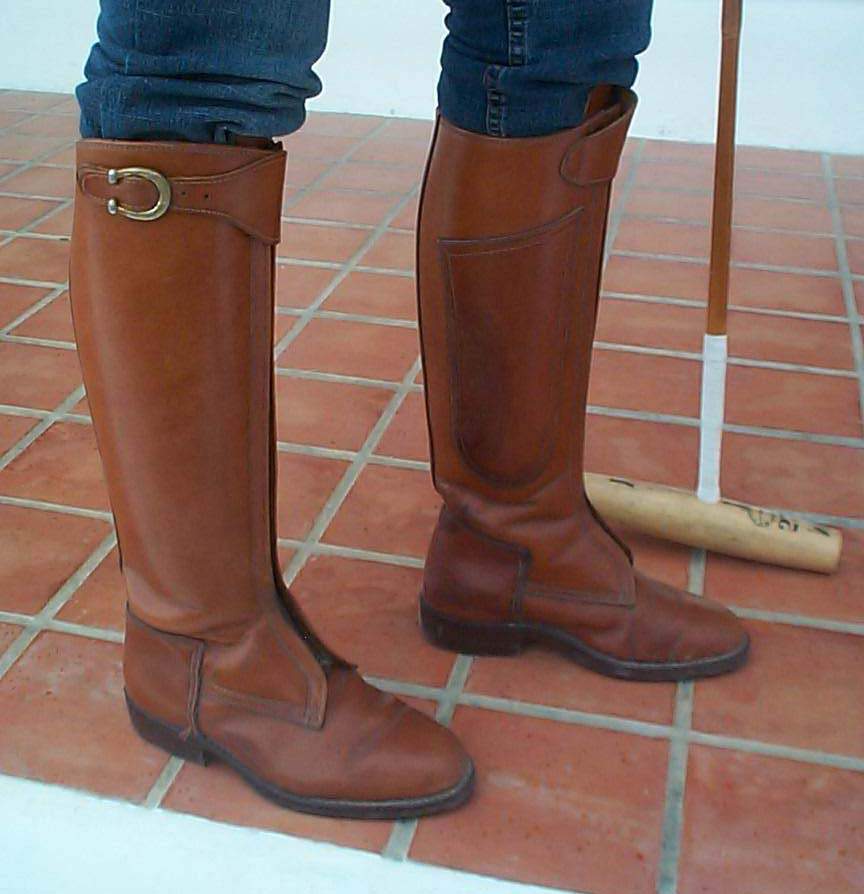
But. But. Having yesterday attended a real-live, honest-to-God polo match, I feel compelled to offer a theory of at least one way in which it might not be entirely indefensible to exist in this otherwise ridiculous realm of excess and ostentation. And it has to do with boots.
How much do the boots these polo players were wearing cost? $700? $900? Who knows. Conceivably enough to pay rent for two months in most mid-sized Midwestern cities. Enough to offend the sensibilities of most everyone I grew up with.
But here's the thing: nobody who's ever played polo buys them because they cost that much. Rather, they buy them because they're worth that much. Stand next to a man standing next to his polo pony, as we did yesterday, and you'll realize what a sophisticated bit of equipment he's wearing on his feet. The zipper, in the classic Argentine design, is on the front and covered with flaps:
Or, sometimes the boot is even covered with "over-chaps" to prevent wear from rubbing against stirrup irons, or the rider's horse, or his opponent's horse should there be contact:
And about that contact--it is repeated and sustained, these boots must endure the press and grate of horse hair, the seep of horse sweat. These boots, magnificent though they are, are not show pieces. Rather, they are made in anticipation of mud, salt, shit, and yes, frequently spilled beer or gin. They are something that seems to have become strangely rare in our time: they are both beautiful and used.
Now, what the brief and rather tame essay above is not, is an unqualified apology for the aristocratic classes such as they continue to exist here in Northern Virginia, or wherever they might be lurking in the Western world. Rather, it is a proposition. I know from my own experience that what might smack of pretension to some is in fact experienced as an earnest and profound engagement by others. I know that when I wonder out loud about some abstruse question, say, whether or not Chinese trade and investment in sub-Saharan Africa constitutes a 21st-Century reincarnation of colonialism, I'm not doing so in order to impress anybody (because, really, who would ever be impressed by that question?); I'm actually thinking about it. And though we do well always to keep a wry eye on our own aspirations, whether they be aspirations to eloquence, expertise, gentility, or what-have-you, we need nevertheless to be free to aspire fully, desperately even. If we are not thusly free, if we allow our skepticism to inhibit our curiosity, or allow our instincts toward moral disapprobation to overwhelm our patience, then we risk missing so much and being the unhappier for it. As you can see below, Nina and I, deeply in touch with our own pretensions, had a blast at that polo match.
Saturday, August 27, 2011
Homes
Because in my estimation George F. Kennan (Milwaukee native, cold war diplomat, and Pulitzer Prize-winning historian) has said most things better than most of the rest of us will ever say anything, I offer here, on the occasion of Nina's and my re-engagement with Lithuania, a quote from Kennan's incomparable memoirs:
“If Wisconsin, then, was not ‘home,’ what was? Well, there was now Princeton, and the farm in Pennsylvania, and the cottage in Norway. But there was more than that. There were those curious places…where I had felt so overpowering a sense of familiarity as to evoke the mystery of a former life. Home, then, was the whole great arc of the northern and western world, from Moscow across Scandinavia and the British Isles to Wisconsin. One was, in other words, a sort of Nordic cosmopolitan, truly domiciled only in the natural beauty of the seas and countrysides of this northern world; in its seasons and its storms…”
Thursday, August 18, 2011
Sentence of the Day
In case, like me, you're not having any fun with your sentences these days, here's one of William Kennedy's:
It was dark now and I was wet to the underwear, standing in the middle of desolation, maybe about to be buried in a landslide, giving traffic directions to a bleeding, one-eyed psychopath who was, with one hand, trying to drive a mythic vehicle backwards up an enchanted mountain.
Now if that don't put the gnats back in your herb garden, what does, huh? ;)
Friday, August 5, 2011
Memorials
What are memorials for, what are they about? Take Abe, above. The stern, but probably not quite admonitory gaze. The impatiently clutched left hand seemingly intended to suggest the impact of those fabled emotional and intellectual burdens which, nevertheless, have failed to degrade the subject's posture or general aura of rectitude. All wonderful, as far as they go. Likely accurate, and therefore evocative. But is that it? Mere evocation? Isn't that a bit obsessive, the constant imperative to remember, remember, remember? Remember what? It almost doesn't seem to matter.
Viewing several of DC's memorials last night with friends who were visiting from, well, Lincoln (NE), I couldn't help sensing a desperation behind our society's drive to remind itself of everything horrible and astonishing. Why? Are we really afraid we'll forget? I don't think so. I think it's more complicated. I think we're afraid we'll lose control of the meaning. We're terrified that what we think we understand today about Abe Lincoln, or the Korean war, will be undermined or reinterpreted. So we try to fix the significance of people and events in time and place. Memorials--always made of stone, or steel. Right?
It's insufficient, of course. People are dynamic, wars unfathomable. We have to know them as we know everything--conditionally.
Ultimately, I don't suppose any of this amounts to a defensible objection to memorials. Indeed, their very insufficiency is probably important. But why can't that insufficiency, then, be our starting point? Why aren't memorials about the insufficiency of memory? Or are they?
Subscribe to:
Posts (Atom)