Showing posts with label chemotherapy. Show all posts

Thursday, May 7, 2015

Cancer Patients and the Cards We Give Them

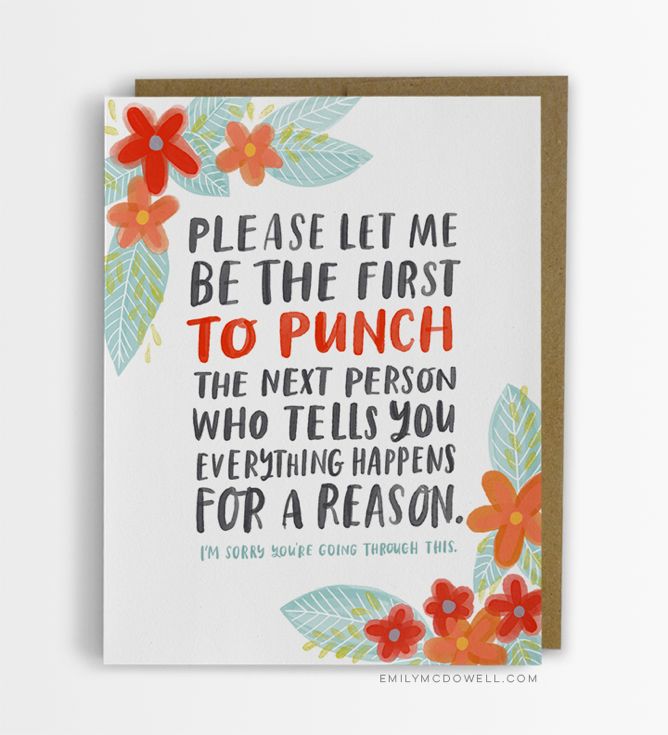
An interesting piece here about the kinds of cards one former cancer patient would have liked to have received during her treatment. 


Most of the cards seem either funny, or heartfelt, or both, but don't they proceed from the same assumption as the more common--though presumably deficient--kinds of sympathy and get-well-soon cards?  Namely, the assumption that the kind of person who would give a card to a cancer patient can have (either through the card, or otherwise) a meaningful impact on the cancer patient's experience? 

I guess I'm falling back here on an experience of the disease and of treatment which not every patient has--that it reduces one's world to essentials.  During treatment, I needed my wife.  I needed the rest, the repose that could be had in the lee of her physical and psycho-emotional shelter.  And I needed the tether to normalcy that my parents and other family provided.  But beyond that, what could anybody really say or do?  It was my job to survive, just to keep breathing until it was all over and I could get on with trying to stand myself up straight again (still working on that, by the way).  And nobody else could do that for me; certainly no card could. Cards were more for those who gave them than for me. 

And--a crucial point--there's nothing wrong with that.  It's ok that nobody could really help me, or be a part of my experience.  And it's ok if someone wants to take action against their own fear or confusion or impotence by the affirmative act of sending a card.  I don't mind. 

Thing is, from the moment of diagnosis, a division arises between the patient and his or her healthy compatriots.  And it was nobody else's fault that they had no idea what was happening to me, or to me with respect to them, or to them with respect to me.  And so I never needed or expected any of them to come up with a card (or a letter, or text, or email, etc., for that matter) that said the right thing.  There was no right thing.  The magnitude of the facts overwhelmed the possibility of saying the right thing, or anything at all, really.  The brute experience was its own meaning, and it happened in silence, and you can't expect anybody who hasn't gone through that to understand it, with or without a well-considered and deeply sincere empathy card.

Wednesday, November 12, 2014

Quo Vadimus, or The Long Bridge

Two years ago around this time I had 30 staples in my side after a pair of nasty surgeries.  The day before Thanksgiving I had the staples out.  One of them didn't want to let go - the doc had to twist and tug, and I almost passed out.  Then I rode down a couple floors in the hospital elevator and had a bone marrow biopsy.  A few days later I flew from Nebraska to Washington, D.C. to start chemotherapy at Georgetown University Hospital.  When we landed, my wife and I checked in at our passable extended-stay hotel in Crystal City (Arlington, VA), and went for a walk on the nearby Long Bridge.

I've no idea why it's called the Long Bridge.  It's not especially long.  It runs out past the Reagan Airport runways, along a marshy part of the Potomac where Eagles sometimes circle, fish, and land in the trees.  The Pentagon sits to the left, across I-395.  A glassy, brand-new Boeing facility is set near the start of the bridge, and at the far end is a rise from which one can see the Washington Monument, the Capital building, and much of DC's leafy, northwesterly spread.  As I was beginning chemotherapy, I went for walks out to that elevated end of the bridge, and stared off into the cold late-fall dusk coming down on the city.  And wondered if I would live.

This past Sunday I flew to the Washington, DC area again, and checked in to a hotel very near where we stayed two years ago, during my treatment.  This time I'd come for the final stage of the Foreign Service entrance exams, the Oral Assessment; if I passed, I'd be (almost) a member of the U.S. diplomatic corps.  I passed.

The next morning, having time to kill before my flight out, I walked to the end of the Long Bridge to look again at the unchanging city.  The day was warm and dry.  Waist-high native grasses along the side of the bridge rustled in the breeze, and I reached out to touch their bristled tops with my palms.  I'd lived after all.

The overwhelming sensation on this day, however, was of the same unhurried, inscrutable presence of the eternal that I'd had two years prior, in a much more dire condition.  Though then I'd been supremely vulnerable and now I was (in my small way) triumphant, I was in each case most aware of the ineradicable uncertainty that underpins all human experience - having now achieved a high goal, I no more knew where I was going, what I was doing, what would happen next, or even if I would live much longer, than I had understood those things back in 2012 when I faced cancer.  The through-line of history is precariousness.  Around this axis revolves a cycle of aspiration and despair, conviction and dismay, hope and then ultimate surrender to the unknown.

I am of this human lineage, and I am intimately familiar with these regular orbits of human emotion.  And I cannot resist the too-perfect metaphor of the Long Bridge as the defining vector of my personal uncertainties.  How many times will I stand at its peaceful terminus and ask, invoking God, and my loved ones, and everybody else too, Quo Vadimus?  Where are we going?

If I'm fortunate, many, many more.


Wednesday, July 10, 2013

The Unexpected Applicability of J. Alfred Prufrock to a Memory of Chemotherapy

The other day I thought of a line from the great T.S. Eliot poem (I grow old... I grow old.../ I shall wear the bottoms of my trousers rolled), and so went to my old Norton Anthology to check out the text.  And saw this there:

But though I have wept and fasted, wept and prayed,
Though I have seen my head (grown slightly bald) brought in upon a platter,
I am not a prophet--and here's no great matter;
I have seen the moment of my greatness flicker, 
And I have seen the eternal Footman hold my coat, and snicker,
And in short, I was afraid.

In short, I was afraid.  It's the starkness of this, the bare admission.  And the obliquely apropos reference to baldness...

Nothing else to say about it, really.  It just caught my eye and felt right.


Wednesday, February 13, 2013

Ashes

Friends, you haven't lived until you've had an infusion of chemotherapy drugs on Ash Wednesday.

I find I am crazily moved by the joy of ashes.  Gorgeous ashes, silvery, strange and potent.  Why would ash ever be an emblem of denial or irretrievable failure?  Ash proves a great success of burning; ash is memory.  We are made of ash, and this is beautiful news.

What a fearsome, magnificent, poetical day.

Wednesday, December 26, 2012

Six Lessons in Humility and Patience

There's an excellent book out there by Prof. Joseph Williams, titled Style: Ten Lessons in Clarity and Grace.  It's a manual of composition in professional writing, and it should be part of every English language high school curriculum in the world, but in particular I've always thought the title was magnificent.  So I stole it.

Why?  What does its reworking here describe?  My six cycles of chemotherapy treatment.

This is what happens on treatment days: I have to come to the 'infusion center' as it's called, and sit in the presence of the terrified, the wrecked, the slowly dissolving, the bewildered, the dying.  They look like hell, busted up and raked over, staring glassy-eyed at their blood pressure cuffs, leaning forward in their recliners to accept a thermometer.  And with them before and around me, I want nothing more than to deny the flatly obvious: that I'm just like them.  My uppity soul.  I don't want to be like them.  I want distance, I want my carefully honed sense of superiority back.  But I can't have it, can I?  Because I am just like everybody else, aren't I.  I stare at the blood-pressure cuff, don't I.  I lean and cringe just like they do, powerlessly.  Oh, what a lesson!  What a bitter, necessary lesson.  A bitter cause for laughter.

And here is what happens after treatment days: I take mega-doses of Prednisone and so can't sleep.  I get nauseous and register actively the smell of absolutely everything, even things that don't normally seem to have a smell.  Muscle spasms, headaches, fatigue, the whole list and litany.  Just like that which everyone else experiences.  And there's nothing to do but bunker up, duck and cover for however many days, because nothing will help.  Wisdom doesn't help, sharing doesn't help, and screw courage, what does courage have to do with it?  It's the waiting that gets you there.  Like a lion, hungry and without options there in the weeds.

After today, four lessons left.  Will I really learn?

Friday, December 14, 2012

The Picasso Answer

I've had a lot of people ask me about writing, about continuing to write during chemotherapy.  Will I be able to write, I've been asked.  Well, yes and no is one accurate and necessary answer.  There are predictable patterns of incapacity in the course of chemotherapy treatments, and they're not to be trifled with, they are no joke, and anyway they impose themselves, there's nothing I can do about it.  But they go away.  And life and vitality seem to return, however provisionally, and use of the imagination seems warranted again.  Or at least that's how this first cycle of treatment, some 11 days in, has seemed to go so far.

But I heard recently an answer to the question that I like far more.  Picasso is reputed to have said it, though I don't know when, where, to whom, or in response to what.  Who cares.  It's the right answer, and right answers are beyond citation.  It's this:
If they took away my paints, I'd use pastels.  If they took away my pastels, I'd use crayons.  If they took away my crayons, I'd use a pencil.  If they stripped me naked and threw me in a cell, I'd spit on my finger and draw on the wall.